
Introduction
I’ve been called a graphic designer, a video editor, a motion graphics artist, and a UI designer — sometimes all in the same week. For a long time, I didn’t know what to call myself. Was I spreading myself too thin? Was I chasing too many things at once?
Then I came across a phrase that stopped me cold. You’ve probably heard it too — “Jack of all trades, master of none.” It felt like a warning aimed directly at me. But here’s what most people don’t know: that’s only half the phrase. The full version reads:
“Jack of all trades, master of none — but oftentimes better than a master of one.”
— The original, complete phrase
That forgotten second half? That’s exactly what a Creative Designer is.
The silo problem
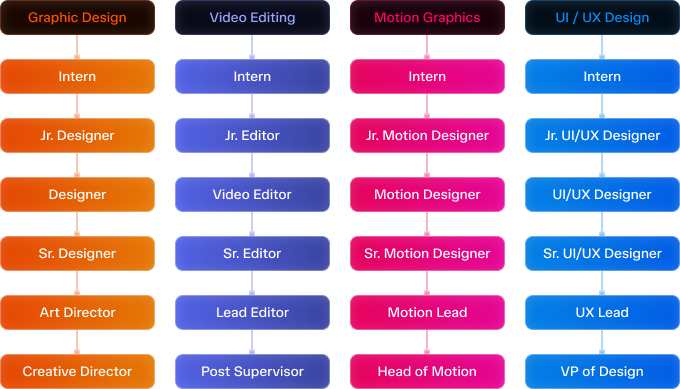
Every creative field has its own career ladder. And they’re built to keep you climbing in one direction. Graphic Design leads to Creative Director. Video Editing leads to Post Supervisor. Motion Graphics leads to Head of Motion. UI/UX leads to VP of Design. Four tracks. Four separate destinations. And at no point do they cross.
Many people know graphic design. Many know video editing. Some know motion graphics. A few know UI/UX. Some even know two of these disciplines. A rare few know three. But who knows all of it — and actually thrives across all of them?

There’s a psychological reason for this. The fear that learning more means becoming worse at what you already know. The brain resists spreading attention. The industry resists it too — job titles are siloed, portfolios are expected to stay focused, and everyone around you is going deeper into one lane.
And then there’s that phrase again — “Jack of all trades, master of none” — used like a warning. Used to keep people in their lane.
The phrase is right — but about the wrong thing. Dividing your attention at the same moment does reduce quality. That’s real. But learning multiple disciplines over time, one after another, does the opposite — it deepens each one. A video editor who learns motion graphics becomes a better editor because they now understand timing and animation at a deeper level. The knowledge compounds. It doesn’t dilute.

There’s a concept in the creative and product industry called the T-shaped skill set — and it’s the closest thing to a framework for what a Creative Designer actually is. The horizontal bar is your breadth — enough understanding of each discipline to contribute, collaborate, and jump in when needed. The vertical stem is your depth — the one area where you’ve gone all the way down and built real mastery.
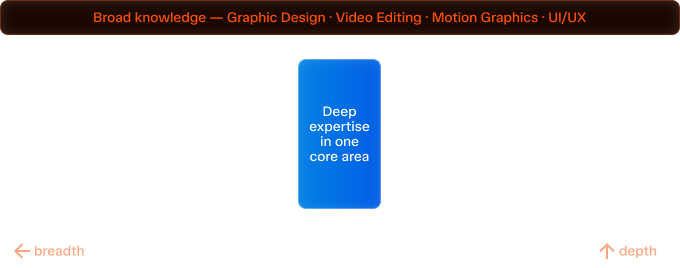
A Creative Designer isn’t someone without depth. They’re someone whose depth is surrounded by breadth. That combination is what lets them hold the entire creative vision together — from the first sketch to the final frame.
What a Creative Designer actually is
From my own experience, this is how it plays out in real work. When I’m building a brand identity, I’m not just thinking about the logo. I’m thinking about how it moves in a video intro. How it translates into a UI component. How a motion transition might carry the brand’s personality forward. That’s only possible because I’ve spent time in each of those worlds — not mastering all of them, but understanding enough of each one to connect them.
You don’t need to master everything. You need to understand how results are made in each discipline — well enough that when the need comes, you can jump in and bounce back. A working knowledge of UI/UX is more than enough. The depth comes when the project demands it.
The secret ingredient
Interest. You can’t fake curiosity. If you genuinely want to know how a motion graphic is built, you’ll figure it out. If you’re forcing it, you’ll plateau fast.
Problem-solving instinct. A Creative Designer looks at a brief and asks — what does this problem actually need? Not “which tool do I know best?” The answer might pull you into a discipline you haven’t used in months. That’s okay.
Learning how results are made, not just how to make them. Once you understand why a cut lands emotionally, or why a typeface choice shifts the entire mood of a layout — you can carry that thinking into any discipline.
An honest note
I’m not perfect at all of this. I still make mistakes. I still have gaps. There are days I feel like I know too little about too many things. But I’ve come to understand that feeling is part of the process — not a sign that you chose the wrong path.
The Creative Designer path asks more of you. More curiosity. More discomfort. More willingness to be a beginner again in a new discipline. But it also gives you something that depth alone rarely does: the ability to see the whole picture — and make it work together.

The next time someone quotes “Jack of all trades, master of none” at you — remind them of the second half. The part that got quietly dropped somewhere along the way.
Being a Creative Designer means you’ve chosen the harder, messier, more rewarding path. You’re not a diluted specialist. You’re T-shaped — rooted deep in what you know best, and wide enough to hold the entire creative vision together.
And that? That’s rarer than any single mastery.